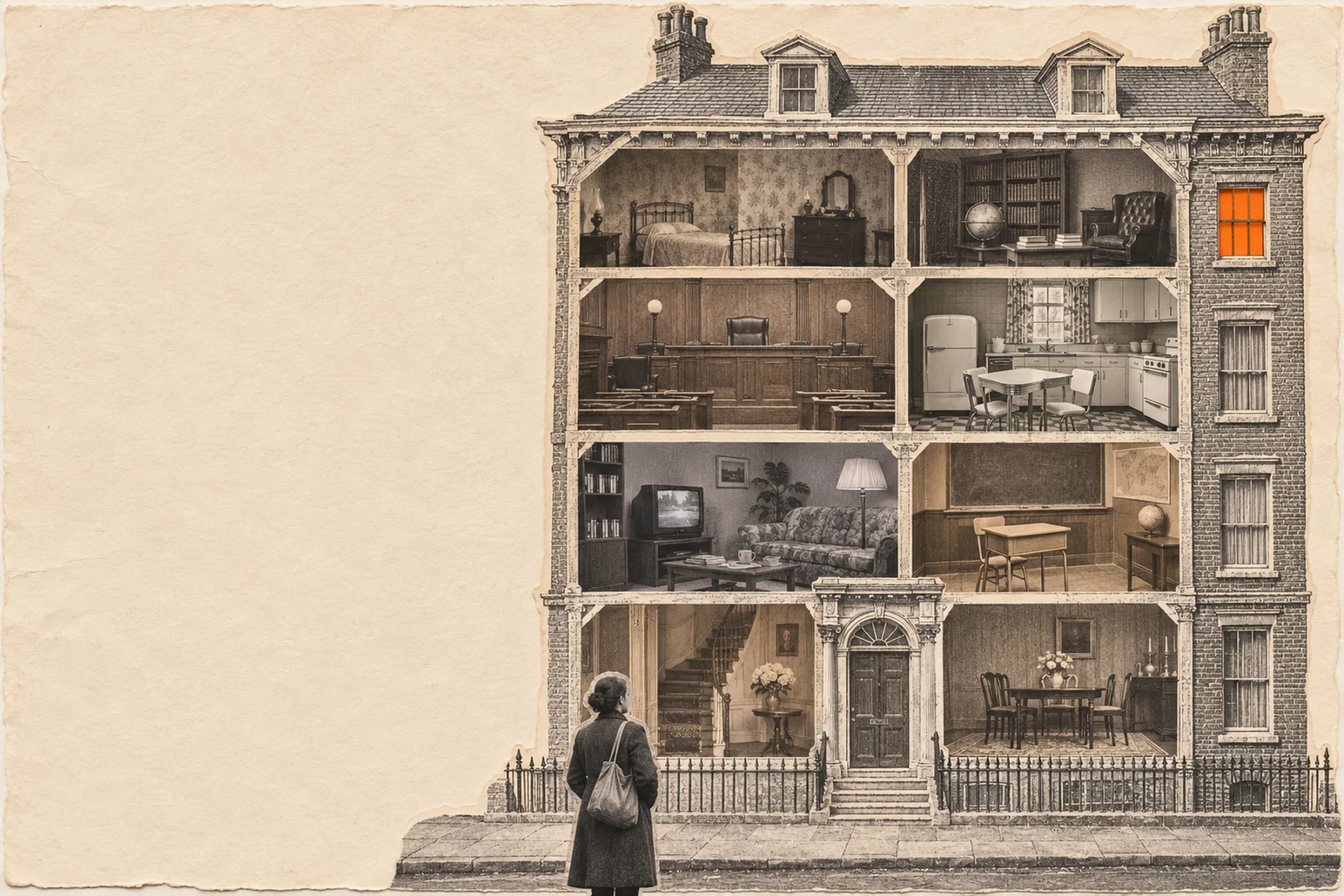
Violence Has a Home. We Call It Society.
On the normalisation of women's devaluation, the privatisation of social responsibility, and the possibility of an emancipation without shame.
Contents
Prologue Congratulations, we are a progressive society.
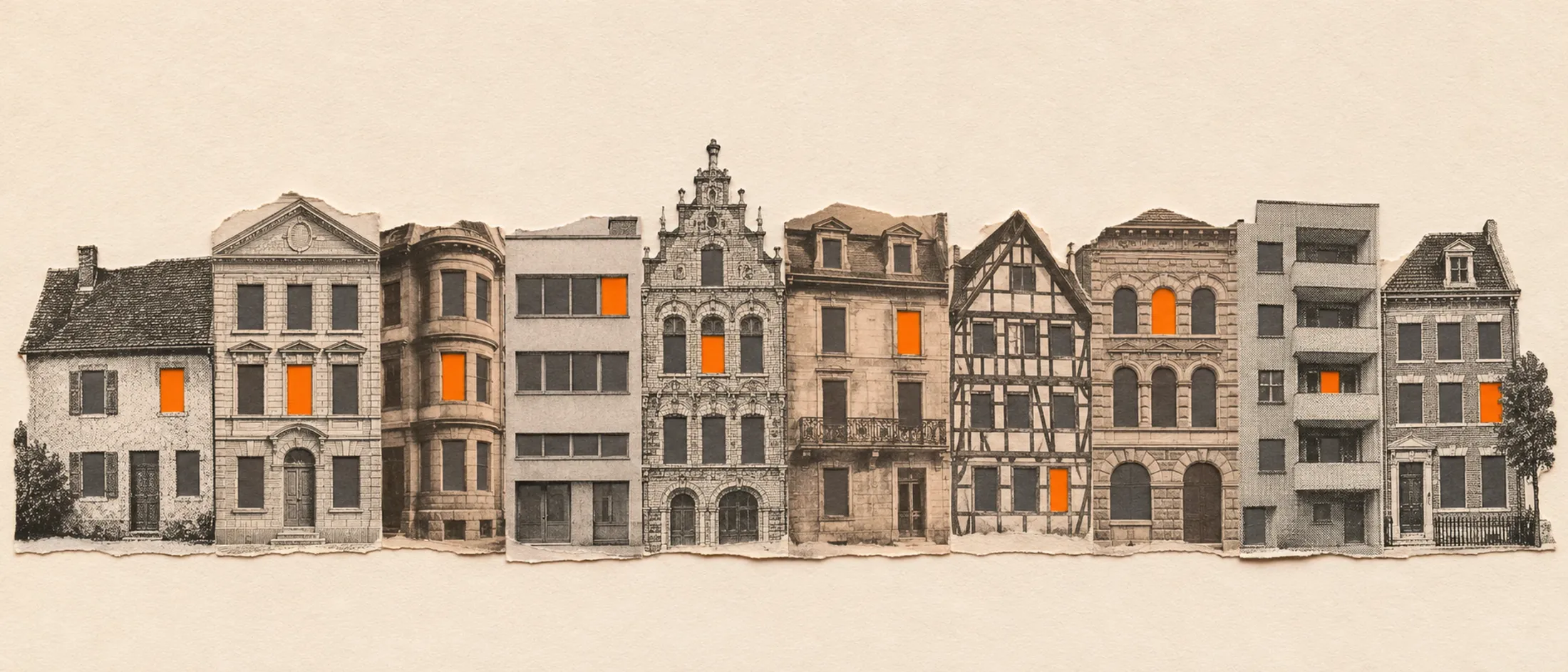
Today we wear orange.
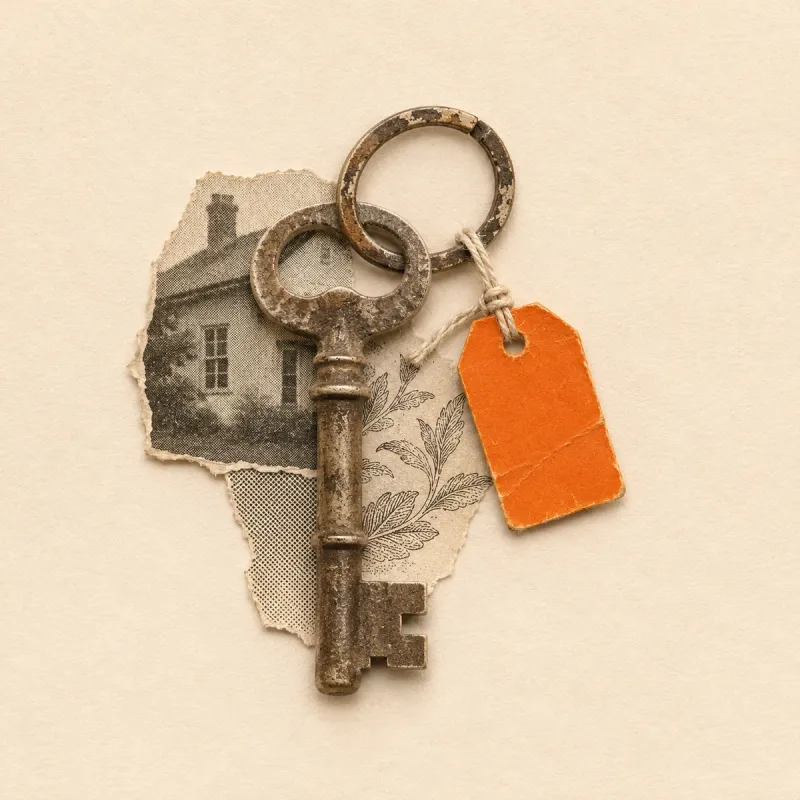
We light up buildings, share statistics, post our solidarity and assure each other that violence against women has no place in our society. Honestly, that is quite a bold sentence for a society where this violence has been living for generations, has a room of its own and has never once been asked to hand back the key.
But fine, we’re progressive. Women may vote, work, start companies and leave their husbands, and since 1997 Germany has also treated rape within marriage as what it is. That achievement is actually younger than many of the people who now debate whether feminism hasn’t gone a little too far.
In its report of 19 November 2025, the World Health Organization estimates that around 840 million women aged 15 and over have experienced physical or sexual violence by a partner, or sexual violence outside a partnership, at least once. That is close to one in three women. [1]
I think at that scale we could very gently revisit the theory of the individually poor choice of partner.
Instead we ask her why she stayed, why she married him, why she had children with him, why she said nothing and why she went back. And when she has left, found help, protected her children and somehow rebuilt her livelihood, we ask her why she is still so angry.
These questions are not curiosity, by the way. Each one moves the crime scene a little further into her, into her decisions, her character, her judgement of people, and as long as we investigate there, nobody has to search the house where it all happened.
So the woman is under permanent observation, while society has published an orange Instagram post today and considers itself excused for now.
This essay is about that society, about its jokes, its ways of raising children, its institutions, its economic interests and its truly remarkable creativity in passing responsibility along. It is about a culture that taught women for centuries to distrust themselves and now offers them paid programmes in which they are meant to learn to trust themselves again.
And it is about the question of how we rebuild a house like this without hanging shame back on the wall as the house rules.

I The normality of the monstrous It was just a joke.
If you grew up in Germany in the nineties and noughties, you almost certainly took part in a particularly successful form of cultural gender education, and it didn’t happen in the classroom. It happened at prime time in the living room, while the comedian Mario Barth stood on stage.
The principle was always the same: the woman voices a need, the man finds that need annoying, and the audience laughs. What exactly she wanted rarely mattered for the punchline, because it was enough that she wanted anything at all.
Of course a sexist joke is not an assault, and obviously nobody becomes violent because they went to a comedy show. The more interesting question is a different one, namely what we all need to share already for the joke to work in the first place.
Humour needs recognition, it works with what everyone in the room already knows. So if we have been able to laugh this reliably for decades at the supposed irrationality of women’s needs, we should honestly ask ourselves which picture of women’s credibility was sitting on the sofa with us every Saturday night.
A joke is something like a rehearsal. In laughing, a whole hall practises hearing a need and not taking it seriously in the same moment, and what you have rehearsed often enough you can eventually do without a stage.
Because at some point the woman leaves the comedy stage and stands in the living room, in the office, in a doctor’s surgery or in front of a family court, and she says that something is wrong. And then she is exaggerating, she is emotional, she is difficult, and once again she is making a drama out of everything.
We have developed an astonishingly large vocabulary for filing away a woman’s objection before we even know what she is objecting to. It is practical, too, because anyone who has successfully filed a woman under oversensitive no longer has to spend much time on the question of what she is actually reacting to.
The social licence to be disbelieved
The philosopher Miranda Fricker has two terms for this problem. Testimonial injustice means that people receive less credibility than their testimony deserves because of social prejudice. Hermeneutical injustice concerns unequal access to the concepts people need to understand their experiences at all and to convey them to others. [2]
Said at the kitchen table: first nobody believes her, and then she doesn’t even have the words.
So what happens to a woman who hears for years that her unease is inappropriate, and who at the same time lacks the concepts to understand what is being done to her? She takes control for care, jealousy for love, and the constant monitoring of her own needs for a relationship skill you simply have to bring along.
She may then not even be fighting the violence first, because before that she has to fight for the understanding of her own reality.
I think this is the part we see worst from the outside. Before she can leave at all, she first has to believe herself, and that is exactly what has been trained out of her for a lifetime.
And even if she manages that, she is then asked to tell the monstrous in a way that lets the people who never lived it feel as comfortable as possible while listening.

II The grammar of violence A drama occurred.
It is truly fascinating what kind of linguistic career a violent man can have under certain circumstances, because sometimes he disappears as early as the headline. It then reads “Family drama after separation”, “Relationship dispute ends fatally” or “Tragedy shakes community”, and apparently conflicts can now act entirely on their own.
The same news could also read: man kills former partner. And suddenly the sentence has someone in it who does something again.
Take the word drama literally for a moment. A drama has an audience and a curtain, it is performed and it befalls those involved. An act has a perpetrator.
These headlines are hypothetical, but they do distribute attention and responsibility differently. I am not accusing everyone who writes “family drama” of deliberately playing things down, and the presumption of innocence applies here too, of course. It’s just that language can blur the difference between a relationship conflict and an act of violence so far that in the end he gets a story and she gets a cause of death.
Christine E. Meltzer’s 2024 trend report on German print media between 2020 and 2022 documents that homicides are disproportionately visible, while everyday forms of violence and structural connections receive little attention. The perspective of those affected and references to support services rarely appear. [3]
So we may learn that the man could not cope with the separation, that he was desperate and that the neighbours describe him as friendly. His emotional state is carefully reconstructed, while the woman appears mainly as the person whose decision set something off in his life.
But a woman is not a man’s failed relationship. She is a person whose life had a story of its own.
Welcome to the land of regrettable isolated cases
Every week it is a different story, a different woman and a different family, and every time we establish once more that nobody could have imagined such a thing.
At what point are we actually allowed to start imagining something that happens regularly?
Placing things in a structure does not mean that all cases have the same causes. It only means that the recurring patterns shouldn’t vanish from the picture every time just because the people involved have different names.
So we have to talk about claims of ownership, economic dependence, gendered upbringing and the protection institutions can offer. That takes not one gram of responsibility off the perpetrator, it only prevents society from hiding behind his responsibility and acquitting itself of its own.
The isolated case is, after all, the most comfortable form of housing there is for this problem. It has an address, a name and a culprit, and everyone else gets to go home again.
III The invisible training to be a woman Congratulations, you’re so sensible.
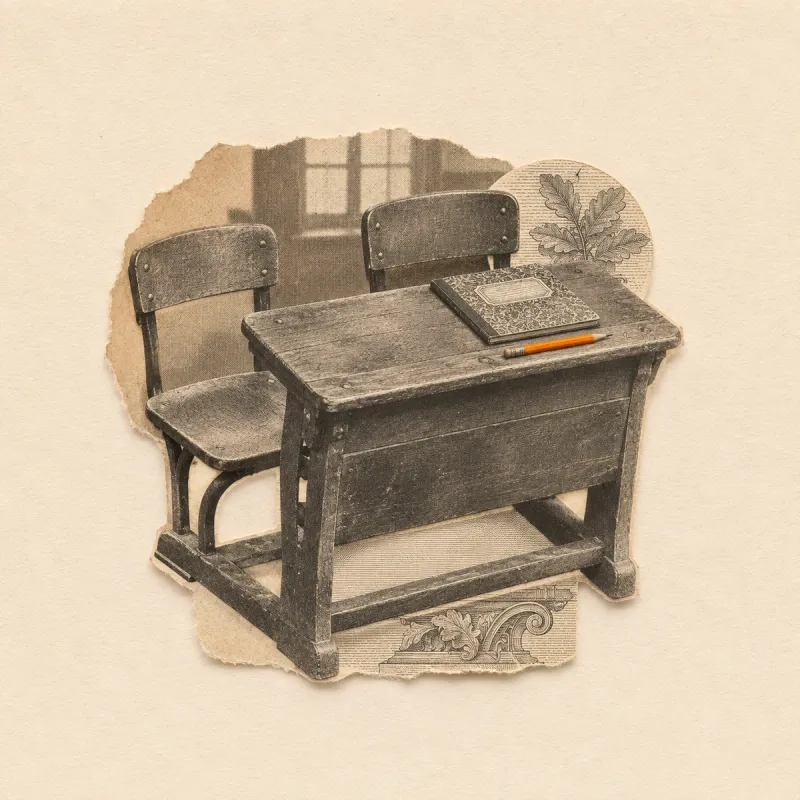
Let’s start with a little girl. She sits in the classroom, works with concentration, disturbs nobody and has long since learned to regulate her impulses. At some point a boy sits next to her who isn’t so good at that yet, and not because she picked him as her neighbour, but because an adult decided that her good sense might do him some good.
With that the girl has received her first promotion, namely to unpaid officer in charge of another person’s personal development.
I don’t believe every seating plan like this is meant in a consciously sexist way. It’s just that her competence becomes the solution to his problem here, her ability to behave earns her additional responsibility, and his missing ability is at least partly compensated by her presence.
She also learns, by the way, how reward works in this house: whoever does well gets more work, and whoever can’t do it gets someone seated beside them.
What have the two children just learned? Probably more about their later roles than in all their general studies lessons put together.
Oh, he just likes you.
A boy pulls a girl’s hair, the girl complains, and an adult explains to her that he is probably only doing it because he likes her.
That is then her first lesson in a remarkable cultural discipline, namely interpreting male boundary violations by way of male feelings.
And yet the girl already knows what she felt. She didn’t like it, and with that the pedagogically decisive information would actually have been on the table.
The far more useful lesson would have been that people who like you also have to respect your boundaries, and that people who like someone have to learn to show their affection in a way the other person doesn’t experience as an imposition.
Honestly, that shouldn’t have to wait until it becomes material for paid relationship coaching in adulthood.
The wrong perspective on raising girls
We tell girls to be confident and correct their tone the moment they disagree. We tell them to know their boundaries and explain to them that they are being rude when they refuse a hug.
So we wish for confident daughters whose confidence is, if at all possible, not directed against our own expectations.
This really isn’t a girls-only issue, because parents of all children have to learn not to take their children’s growing autonomy as a personal insult. It’s just that the upbringing of girls has historically been tied especially closely to care and adaptability.
A self-determined daughter will one day make a decision we personally think is wrong, and in exactly that moment it will show whether we really wanted to teach her self-determination or merely a more confident form of obedience.
Women are not the natural guardians of patriarchy.
They can, however, administer its rules with remarkable competence. They can judge other women for their bodies, their sexuality, their career decisions and their ideas of motherhood.
In 1988 Deniz Kandiyoti described, with the concept of patriarchal bargaining, how women develop strategies within existing gender orders to gain security and room to act. [4]
Whoever has learned that adaptation is rewarded with belonging will naturally recommend that strategy to other women too. And whoever has made considerable sacrifices to satisfy a norm may experience it as a rather painful encounter with their own past when somebody suddenly questions that norm.
Maybe I wouldn’t have had to put up with all of it. Maybe what I took for my duty wasn’t my duty at all.
I think that is why older women’s criticism of younger ones so often sounds like anger and is really grief. If the daughter is allowed to do it differently, then the price you paid may have been for nothing, and that is harder to bear than any rule.
That’s why we must not simply explain it with personal malice when women pass on patriarchal ideas. Otherwise we would once again have translated a social dynamic into a female character flaw.

IV A historical blink of an eye Your grandmother is not a historical era.
A woman born in West Germany in 1950 was 27 when the legal model of the housewife marriage was abolished, and 47 when rape within marriage became a criminal offence as such. Today she is 76.
So she is not a historical footnote, she may well be sitting at your kitchen table right now.
A law can be changed on a particular day. The ideas millions of people grew up with unfortunately don’t receive an automatic software update.
They go on living in families, in what we picture a relationship to be, and in that remarkable collection of behaviours we call common sense as soon as we would rather not deal with where it came from.
That is what I mean by home. You can swap the nameplate and reprint the house rules, and still everyone who grew up there knows in the dark where the light switches are.
She doesn’t belong to you. Not even a little.
Legally we have accepted that women are nobody’s property. Culturally this information seems not to have fully arrived in places.
A woman may leave a relationship, but why is she doing this to him? She may not feel like having sex, but does she ever think about what that does to him? She may pursue her professional ambitions, but then who looks after the family?
In each of these sentences the permission stands at the front and the bill at the back, and the “but” in between is the spot where the old claim of ownership still lives.
Other people’s needs are legitimate, and relationships need mutual consideration. It’s just that the fact that another person’s decision affects my life gives me no right whatsoever to make that decision for them.
Autonomy is not a friendly offer we make to others on the condition that their decisions suit our ideas. It really only begins where people can make decisions we don’t like.

V The glass dome of motherhood Please reproduce responsibly.
A modern woman is supposed to be financially independent. She is supposed to have children, provided she is a woman with the right priorities in life, and then accompany those children intensively, stay mentally healthy while doing so, advance her career, tend her partnership, organise her pension and make sure her own unprocessed childhood experiences don’t land on the next generation.
And of course she shouldn’t forget to regularly take time for herself, perhaps between 03:14 and 03:22 a.m., because self-care is important.
We declare the raising of the next generation indispensable to society and at the same time treat a considerable share of its economic consequences as the private risk of the people who take on the task. Research on income losses after the birth of children shows that in many countries these costs are distributed very unequally between mothers and fathers. [5]
A mother’s love is not social insurance.
A company that employs staff calculates the cost of its workforce. A society that needs future workers seems, by contrast, to partly assume that their care and development are already covered by a sufficiently ambitious form of female love.
Love is apparently an excellent method for separating services to society from what they actually cost to produce.
And the brilliant part is that love is so hard to negotiate over. Whoever asks for security in return for something they do out of love instantly looks as if they loved less.
Women love their children. That still doesn’t make a viable pension system.
The good mother must want everything. And nothing for herself.
A mother can look after her children superbly and still violate social expectations because she wants a career, a new partner or a trip on her own. The care she actually provides may then take a back seat to the assessment of her personal priorities.
And that is exactly the glass dome. I don’t mean the responsibility for children, that is real, necessary and in no way optional. I mean the idea that this responsibility comes with a social licence to morally monitor a woman’s entire existence.
Under a glass dome you are both at once, namely protected and on display. Anyone can look in from outside and comment on how things look in there, and you are kindly not supposed to come out.
No children? Also wrong.
Why don’t you want children? Maybe you haven’t found the right one yet? Won’t you regret it later? Behind this lies, every time, the remarkable idea that a woman must justify her reproductive decision to others in more detail than they justify their decision to interfere in exactly that decision.
Women who are childless without wanting to be can also suffer from the cultural equation of fulfilled womanhood with motherhood.
Maybe a woman is simply a human being, with or without a uterus, with or without children, with or without a partner. A daring thesis for the year 2026, but we could give it a try.

VI The well-behaved victim Please suffer appropriately.
There is apparently a socially accepted way of experiencing violence. You should be as innocent as possible before it happens, act as sensibly as possible while it happens, and afterwards develop as few behaviours as possible that suggest it really happened.
A little distress is welcome, of course, the story has to be believable. Just not too much of it, please, so not too angry, not too distrustful, not too contradictory and above all not too exhausting.
And if at all possible, the woman left the perpetrator right after the first violation, has sufficient savings, cares for her children without interruption and can present all relevant events in chronologically flawless documentation.
You do sometimes wonder whether we expect survivors of violence to be human beings or superbly organised project managers of their own abuse.
As early as 1986 the Norwegian criminologist Nils Christie described, with the concept of the ideal victim, that the social status of a victim by no means arises automatically from the fact that someone has been wronged. [6] Certain people are granted this status more readily than others. And yet human rights shouldn’t really depend on how likeable we find the person whose rights were violated.
I think the well-behaved victim exists mainly for us. If there is a right way to experience violence, then there is also a wrong one, and as long as we find the wrong one in her, we can go on believing it wouldn’t happen to us.
Congratulations. Your trauma symptoms count against you.
The psychological consequences of violence can include anxiety, sleep disorders, heightened vigilance, dissociation and difficulties with emotional regulation, among others. These are possible consequences, not traits of all survivors and of course no independent proof of violence either.
Now picture a woman who has learned over years that her statements are disputed, and who therefore explains her experiences in particular detail. She comes across as exhausting. Another has learned that cooperation doesn’t protect her and therefore meets certain procedures with distrust, so she comes across as uncooperative. And a third has learned that her boundaries are regularly crossed, now defends them with particular firmness and thus comes across as aggressive.
The social machine has pulled off a remarkable trick here. It has taken the consequences of a problem and used them as evidence that the person affected may herself be the problem.
That is roughly like setting someone’s house on fire and afterwards holding it against them that they smell of smoke.
A bad husband, but a good father?
Of course parental fitness has to be assessed case by case. A relationship conflict is not yet violence, and a failed partnership doesn’t automatically make anyone an unfit parent. It’s just that partner violence is not simply a failed partnership either.
Children can be severely affected by violence against a parent even when they are not physically attacked themselves. What do children learn about relationships when they watch one parent control the other, and what do they learn about boundaries, responsibility, love and the consequences power has in this society?
The Council of Europe’s expert group GREVIO documented, in its 2022 report on Germany, shortcomings in how domestic violence is taken into account in family-law custody and access proceedings. [7] That is not a blanket condemnation of German family courts, it is an institutional mandate to review.
Because you cannot hold a mother responsible for protecting her children and at the same time regard her attempts to establish that protection as problematic on principle.
When cooperation becomes the continuation of control
With the concept of coercive control, the sociologist Evan Stark developed an approach that doesn’t pin partner violence only to individual physical assaults. What also matters are the longer-term patterns of surveillance, restriction, isolation and control. [8]
So when a woman refuses to communicate with her former partner, under certain circumstances this can be something quite different from a lack of communication skills. It can be the attempt to escape further control.
Whoever automatically treats both sides of such a relationship as equally responsible parties to a conflict risks putting control and resistance to control in the same drawer. That makes about as much sense as inviting a person who wants to break down a door and a person holding it shut from the inside to joint mediation over their differing views on door management.
Not every woman can simply leave, you know.
A woman with her own income, savings, secure residence status and a supportive circle has different options from a woman who is financially dependent, has a disability, relies on personal assistance or whose right to stay is tied to family circumstances.
The legal scholar Kimberlé Crenshaw has shown with her work on intersectionality why different relations of power and discrimination cannot be looked at separately. [9] A woman doesn’t experience her gender first, then her economic situation, and on weekends, where applicable, her disability as well. It all acts at once.
“Just leave” is therefore a sentence you have to be able to afford, and usually it is the person saying it who can.
Difficult women have human rights too.
A woman may be unlikeable. She may have made mistakes, be angry and have made decisions we personally can’t follow. She may leave a relationship and later return, and she may bear responsibility for certain actions herself and still have been wronged by other people.
Recognising that wrong does not require canonisation.
A woman doesn’t have to be a good person for the violence against her to be wrong.
VII The dangerous anger of women Why don’t you smile?
There is a really practical method for not having to deal with a social injustice, and it consists of dealing with the tone of the person raising it instead.
A woman describes an injustice, and she is angry. Now we can either check whether this injustice actually exists, or we can discuss whether she hasn’t perhaps become a little bitter.
Hysterical then. In her masculine energy now.
The history of hysteria is complicated. Diagnoses and treatments changed, and men were diagnosed this way too. Its close historical link to female emotionality and social ideals of femininity is nonetheless well documented. [10]
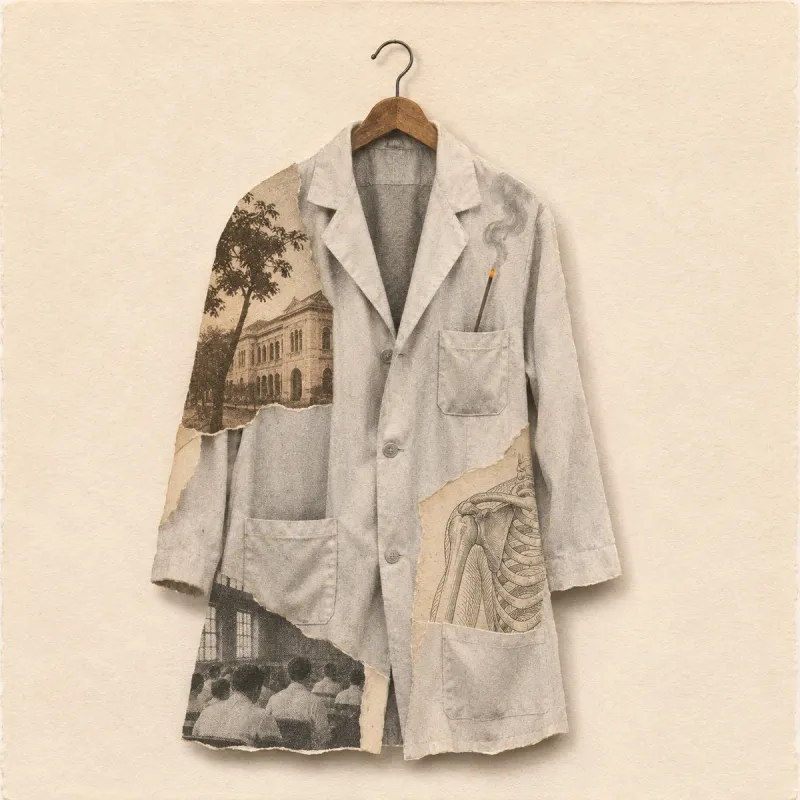
Who actually decided how a healthy woman has to behave? If obedience, domestic orientation and emotional adaptability count as natural traits of women, then female resistance very quickly looks like a deviation from healthy female nature, and the social expectation gets to wear a doctor’s coat.
Today we have other words for it, namely emotionally unstable, bitter, aggressive, man-hating, unhealed, or indeed too much in her masculine energy.
So the doctor’s coat is now made of linen and smells of incense, but it still does the same job: it declares her objection a condition that needs treating instead of a statement that would need answering.
These words are not automatically unjustified. Women too can behave aggressively, develop prejudices or harm other people. We should only prick up our ears when such labels regularly replace engagement with what she actually said.
A woman’s biography is not a counterargument, and her anger is not counterevidence.
He is assertive. She is difficult.
In 2008 Victoria Brescoll and Eric Uhlmann examined in several experiments how the expression of anger affects the status attributed to men and women in a professional context. Male anger could be associated with higher status, female anger was judged more negatively in the situations studied. With men, external circumstances tended to be considered, with women, personal traits. When an external cause for the woman’s anger was explicitly named, the gender bias disappeared in these experiments. [11]
So the man has a reason, and the woman has a problem, apparently with herself.
For me, by the way, the last sentence of that study is the most important one. As soon as the reason for her anger is said out loud, the bias disappears. So the anger was never the problem, it’s just that nobody asked for the reason.
Women now inherit resistance too.
More and more, women grow up with stories of women who refused to go on meeting certain expectations. They have words at their disposal that earlier generations didn’t have as a matter of course, and they can see that female resistance doesn’t necessarily end in isolation.
So women inherit not only the history of their oppression, they increasingly inherit the history of their resistance as well.
A grandmother could have learned that certain things in a marriage are not spoken about. Her daughter could have learned that they may be spoken about. And her granddaughter can already grow up convinced that these things shouldn’t happen at all.
And at some point the old threat simply stops working, because the woman who is told she is difficult may answer: Yes. For whom, exactly?
In The Uses of Anger, Audre Lorde wrote about the political and insight-giving meaning of anger in the context of racism. [12] That context matters, because even within feminist movements not every woman has the same experiences.
Anger is not an infallible source of knowledge. But it can indicate that a person no longer takes for granted an imposition they have put up with until now. A woman who is ashamed of her exhaustion may be examining her resilience. A woman who gets angry about her exhaustion may be examining the distribution of the work.
In doing so she may be ending a decades-long investigation into her own supposed inadequacy and starting to take a look at the world.
VIII When society lives on in the body But she’s functioning.
We admire women who simply keep functioning under extraordinarily difficult conditions, the mother who works despite lack of sleep, or the woman who rebuilds her livelihood after violence. We call them strong, and sometimes that compliment is a remarkably cheap alternative to actually helping them.
Resilience is not a free resource.
With the concept of allostatic load, the neuroscientist Bruce McEwen examined what repeated and chronic adaptation costs the body over time. [13] The biological mechanisms that let us respond to strain in the short term themselves contribute to health risks under permanent demand.
The World Health Organization also documents far-reaching health consequences of partner violence, including chronic pain, sleep problems, depression and post-traumatic stress disorder. A large Swedish cohort study by Song and colleagues additionally found, in 2018, a statistical association between diagnosed stress-related disorders and autoimmune diseases occurring later. [14]
That is expressly not proof that suppressed feelings cause autoimmune diseases. The human body is not a spiritual letter of complaint we merely need to read correctly, and autoimmune diseases have complex genetic, immunological, hormonal and environmental origins.
But the research does open a question that concerns all of us, namely how we distribute strain that matters for health, and who bears the consequences in the end.
In this calculation, “strong” is something like an overdraft. You can live on it for a long time, it looks perfectly solid from outside, and at some point the body pays the interest.
The invisible second opponent
One of the most far-reaching consequences of years of devaluation is, I believe, that a person adopts the language of their surroundings and turns it against themselves.
The woman then checks her perception, questions her needs and apologises for her exhaustion. She tries to understand why others hurt her and at the same time condemns herself for not having protected herself better.
So she is fighting on several fronts, against the outer conditions, against their consequences and against herself.
For others she musters an extraordinary degree of understanding. She knows her partner’s difficult childhood and understands his insecurities, and for herself she may have only a single sentence left: I should have known better.
That is a remarkable distribution of moral generosity and a pretty draining way to exist.
At this point the violence no longer needs a home from outside. It has moved in, it now speaks in her voice, and that is why it isn’t enough if only the man moves out.
The society of unwritten books
We like to measure social success by what people produce, by companies, scientific findings, art, books and technical innovation. What we can measure far less well is what could have come into being under different conditions.
How many books were never written because the woman who could have written them was busy for years organising her own safety? How many companies were never founded, and how many scientific questions did nobody ever ask?
We will never know these numbers, but that doesn’t make the loss any smaller.
A society that uses up women’s strength to balance out its own contradictions doesn’t only lose female potential. It loses human potential.
And afterwards it may take the lower visibility of women’s achievements as evidence that women are simply less ambitious, less willing to take risks or less innovative.
That would be roughly like entering two people for a marathon, handing one of them the organisation of the event along the way, and then being surprised at her slower time.
IX The five shifts of the modern woman Emancipation with overtime.
Women gained access to education, paid work, economic independence and political participation. What we partly forgot in implementing these achievements, however, was redistributing the tasks that were already there.
So we opened up new possibilities for women and left them a surprising number of their old responsibilities.
1. Paid work
The woman is supposed to be financially independent, and that makes sense. For that, though, she needs time, health, education, access to work and, where relevant, childcare that functions. If any of that is missing, she may receive a recommendation for better career planning, while the social infrastructure tends to stay outside the frame.
2. Reproductive work
People have to be cared for, children raised and relatives nursed, and households have to run. This work is the precondition of every productive economy, and yet, as long as it is done unpaid, it doesn’t bring the same security as ordinary paid work.
Arlie Hochschild and Anne Machung described this additional load as early as 1989 in The Second Shift. [15] The woman comes home from work and is at work again, only the pay structure has changed.
3. Cognitive and emotional work
There is a difference between completing a task and being in charge of anyone noticing that the task exists at all.
In her research on cognitive household labour, Allison Daminger distinguishes between anticipating needs, identifying options, making decisions and monitoring the results. [16]
Whoever goes shopping when asked takes on a task. Whoever has to keep all the household’s needs in their head takes on responsibility for a system. And whoever regularly has to explain to the other person what they could take on within that system isn’t necessarily relieved, they may simply have gained one more management job.
4. Safety work
Organising your own safety can tie up an astonishing amount of energy. It starts with everyday decisions about routes, situations, communication and boundaries, and under violent living conditions shelters, legal support, financial security and the protection of the children come on top.
This work has a particularly thankless quality. When it is done well, possibly nothing happens, and because nothing happened, the people around may conclude it was never necessary.
5. Generational work
Many people don’t want to simply hand their children the same emotional and social patterns they grew up with. They question their upbringing, try other ways and learn to resolve conflicts differently.
Whoever raises a child while working through their own upbringing takes on two developmental tasks at once. This work is not female by nature, and that is precisely why we should look at how it is distributed between the genders.
The Five Shifts of Modern Womanhood is an original HOTU model of analysis. The categories can overlap and do not affect every woman equally. It is a theoretical draft, not an empirically validated scale.
And now this woman is kindly asked to also meditate regularly, sleep enough, tend her friendships, eat a balanced diet, regulate her hormones, discover her femininity and work on not being so stressed all the time. Maybe we should sell her another course.
The class question empowerment doesn’t like to talk about
A wealthy woman can outsource part of her work. She can employ cleaners, pay for childcare and organise personal support, and that can considerably widen her own options. Only the work doesn’t disappear as a result, it is taken on by other people, and often those are other women.
So under certain conditions one woman’s emancipation can rest on another woman’s poorly paid care work. That doesn’t mean paid support is a problem in principle. It means that working conditions, social security and economic power belong in our idea of emancipation.
Individual advancement is an achievement, but it is not yet collective liberation.
Otherwise we haven’t redistributed the housework at all. We have merely passed it one floor down, to a woman who has no lift.
Maybe the next phase of women’s emancipation is therefore not about enabling women to perform even more, but finally about negotiating which work they should no longer be expected to do as a matter of course.
X The Personal Is Political How to successfully release a society from its responsibility.
Here lies the actual centre of this essay. We have developed a remarkably efficient method of acknowledging social problems without therefore having to solve them socially: we declare them personal problems.
If a woman is exhausted, she needs better self-care. If she is financially dependent, she needs a better relationship with money. If she experiences boundary violations again and again, she needs better boundaries, and if she suffers from the consequences of years of violence, she needs therapeutic support.
All of that can be sensible and really help. The decisive question is only why we talk so readily about coping with social problems while their origins get noticeably less attention.
A hundred thousand private matters
In 1959, in The Sociological Imagination, C. Wright Mills distinguished between personal troubles and public, structural issues. [17] When a single person becomes unemployed, their qualifications and decisions may play a part. When millions become unemployed, we additionally need an analysis of the economic system.
This distinction makes immediate sense, until we start talking about women.
When women in large numbers experience economic disadvantages through motherhood, we talk about their individual career decisions. When they suffer in large numbers from unequally distributed care work, we talk about their communication skills. And when they experience violence in large numbers, we talk about their choice of partner, their attachment patterns and their personal coping strategies.
That these experiences have something in common is not even necessarily denied. It just astonishingly rarely becomes the basis of our solutions, and so a hundred thousand women with comparable problems remain a hundred thousand private matters.
It is as if every single house in a street were on fire and we sent each resident a guide to the safe handling of candles.
The five phases of shifting social responsibility
The Privatization of Structural Responsibility, an original theoretical HOTU model:
- Normalisation: That’s just part of it.
- Individualisation: Why can’t you cope with it?
- Privatisation: You have to do something about it.
- Moralisation: If you really worked on yourself, this would be long solved.
- Reproduction: The original conditions remain in place.
Take a woman who is chronically exhausted after several years of unequally distributed care work. First her load counts as a normal part of motherhood, then her exhaustion becomes an individual health problem. After that she receives recommendations on stress management, better organisation and self-care, and if she can’t implement them successfully, her willingness to change personally may be called into question.
Meanwhile the original distribution of the work may not have changed at all.
So society hasn’t solved the problem. It has merely commissioned a woman to solve it.
The trivialising that dresses up as compassion
Nobody has to explicitly deny a woman’s suffering. We may regret it, show her compassion, support her therapeutically and admire her strength. As long as we regard her suffering mainly as an individual problem, no obligation to change anything follows for society.
So the trivialising doesn’t necessarily consist of talking the suffering itself down. It consists of keeping its social significance small.
In this form, compassion is a very elegant way of doing nothing. You feel like a good person, she feels seen, and the door behind which it happened stays shut.
Capitalism has understood your problem. Here is your discount code.
A society that chronically overburdens people can produce a remarkably successful market for coping with chronic overburdening. There is stress management, resilience training, money mindset, self-love, attachment coaching and nervous system regulation, plus programmes for rediscovering your femininity and programmes for overcoming the consequences of exactly those ideas of femininity that other programmes are busy selling again.
That these offers exist is not the problem, many therapeutic, counselling and educational services can support people considerably. It becomes a problem where their social function is no longer to widen people’s options but to adapt them as efficiently as possible to unchanged conditions.
Society produces the problem, the woman pays for working on it, and if she doesn’t succeed, well, she can always buy another programme.
The neoliberal career of self-determination
Feminism fought for women to be allowed to shape their own lives. A certain cultural reading of that promise turned it into women being responsible for every outcome of their lives themselves, and that is a fundamental difference.
If every woman can theoretically succeed, her lack of success easily becomes personal failure. If every woman can theoretically leave a relationship, her staying easily becomes a personal mistake.
The work of Angela McRobbie, Rosalind Gill and Catherine Rottenberg offers different theoretical approaches to this link between female self-determination, neoliberal self-responsibility and permanent self-optimisation. [18–20]
Freedom has material preconditions. A woman can be legally free to leave a relationship and still find no affordable flat. She can be legally free to advance professionally and still have no reliable childcare.
A door standing open is not an exit if there is no floor behind it.
Who gets the benefit? Who pays the bill?
The economy needs future workers, and society needs people who look after other people. Families need emotional and organisational work, and the next generation benefits from people who try not to pass on destructive patterns.
Nancy Fraser has examined this tension between capitalist production and social reproduction. [21] An economy can depend on preconditions whose creation it does not itself sufficiently make possible.
The service is used by society, and the costs are privatised.
No, this doesn’t take a conspiracy.
An employer wants to work efficiently, a family wants to organise its childcare, a therapist wants to help a woman, a court wants to conclude proceedings and a company wants to sell a product. Those involved need no shared intention at all for their decisions to reproduce social inequality together.
Structural critique looks at the consequences of this interplay. And it demands that we look for responsibility not only where someone expressly intended to do harm.
The personal is political. But not everything personal is politics.
People have individual room to act. They make decisions, they can learn, change and take responsibility for their behaviour. A social critique that denies this entirely would once again declare people passive objects of their environment.
A woman can learn to defend her boundaries, and other people still remain responsible for not crossing them. A woman can work through the consequences of violence, and the perpetrator remains responsible for his violence. And society remains responsible for guaranteeing protection and prevention.
Self-empowerment widens options. Privatisation transfers the duty to cope.
We may support women in changing their lives. We just mustn’t derive from that a justification for leaving the world they live in exactly as it is.
XI The asymmetrical emancipation Who forgot to bring the men along?
We have increasingly taught girls that they don’t need a man to lead a complete life, and that is an eminently sensible development.
What we may not have done with the same consistency alongside it was teaching boys how to lead a complete life without a woman organising a considerable part of it for them.
And now these people meet. The woman has learned to provide for herself and to take her needs seriously, she may have spent years questioning her relationship patterns, examining her boundaries and developing emotional skills. And then she is supposed to be delighted again that someone voluntarily empties the dishwasher.
Why should he learn something someone else does anyway?
People develop skills partly because they need them. Whoever has to run a household alone presumably learns it at some point, whoever has to tend their own relationships learns just that, and whoever has to bear the consequences of their own decisions may decide differently.
But what happens when those consequences are regularly absorbed by others? Then the pressure to develop simply turns out lower.
This is exactly where it is worth going back to the little girl in the classroom whose good sense was meant to make up for a boy’s missing self-regulation. We used her development to compensate for his difficulties, and it may even have been well meant.
Only it also took something away from him, namely the opportunity to learn it himself. The seating plan overtaxed her and undertaxed him, and both come due twenty years later in the same kitchen.
This is not a claim that men are fundamentally less capable of development. It is the question of which incentives to develop a society sets, and why a system should demand certain skills with any urgency when their absence is already made up for by other people’s unpaid work.
Maybe she simply prefers to be alone.
When a woman decides against a partnership, it tends to get a psychological reading. She then has a fear of commitment, was hurt, is too independent, has unrealistic standards or, a particular favourite, is too much in her masculine energy.
But maybe she simply did the maths, and not only financially, but with a view to her time, her emotional strength, her quality of life and her possibilities. And maybe the result was that a certain form of partnership doesn’t enrich her life enough.
For many women today a relationship no longer has to be the precondition of their economic or social existence. It can be a voluntary decision, and part of a voluntary decision is that you can also decide otherwise.
That is not a defect of emancipation. It is its purpose.
Male loneliness is a problem. Women are not its infrastructure.
Male loneliness deserves serious social attention. People need belonging, friendship, closeness and support, and men too suffer from ideas of masculinity that devalue vulnerability and tie their worth to economic success, dominance or sexual recognition.
But why is the solution to male loneliness so often sought in the availability of romantic partners? Why don’t we talk far more about friendships between men, about emotional education for boys and about spaces where men get support without risking their status?
Men deserve emotional support, and women do not owe them a partnership because of it. Both can be true at once.
Everything was better back then. For whom, darling?
The current longing for traditional gender roles is often justified with the supposed stability of earlier families. Marriages lasted longer, families stayed together, and everyone knew what their job was.
That sounds extremely cosy, as long as we don’t look more closely at what a woman had to expect economically and socially if she no longer wanted to do her job.
A marriage you cannot leave for lack of alternatives is not automatically a particularly successful marriage. A household that functions because one person is almost entirely available is not automatically organised fairly, and a family in which violence is not named in public is not automatically harmonious.
Nostalgia likes to remember the results and leaves the bill in the archive.
So the house wasn’t more stable back then. It simply had fewer doors that could be opened from the inside.
When privileges suddenly become human rights
Joseph Vandello and Jennifer Bosson’s research on precarious manhood examines, among other things, how manhood can be experienced as a social status that has to be earned, proven and defended. [22] When that status is closely tied to superiority, providing, sexual recognition or authority, social change can feel like a personal threat.
When women no longer depend on certain male contributions, the social meaning of those contributions changes too.
When women don’t want to enter a relationship, men lose no right by it. The same holds when women decline sexual acts, and it holds when they organise their own economic existence.
What may be lost is a previous expectation of female availability. And maybe we as a society still have to learn to tell the loss of a right from the loss of a privilege that had come to feel self-evident.
The manosphere has found a business model.
A young man is lonely and afraid for his economic future. He may not know how to build fulfilling relationships and is under pressure to be successful, attractive and in command.
These problems are real. And then he comes across digital offers that explain to him that the cause of his difficulties lies mainly in the emancipation of women, that he has to become more dominant, richer and more superior, and that women are basically a predictable resource in a social status competition. [23]
His insecurity thus becomes a product that can be sold, and his wish to belong can turn into political hostility towards female autonomy.
We shouldn’t simply laugh at these men. That would be humanly questionable and analytically extremely convenient. We should look at why certain explanations of their situation seem so attractive to them and who earns from marketing those explanations.
It is, by the way, the same business model as the discount code further up, only with a different target group. She is sold the work on herself, he is sold a culprit, and in both cases the house stays as it is.
Their loneliness deserves support. Their misogyny deserves contradiction.
And sometimes the backlash becomes law.
On 24 June 2022, in Dobbs v. Jackson Women’s Health Organization, the Supreme Court of the United States overturned the federal constitutional protection of abortion. [24]
The decision was the result of a long legal, religious and political struggle with differing moral convictions and political interests. Regardless of those motives, though, it shows something decisive, namely that rights once won are not automatically secured for good.
Reproductive self-determination concerns a person’s body, health, economic situation and future life. Whoever limits its exercise by law influences decisions of extraordinary reach.
And there it is again, the question that runs through this whole essay: who holds the power to decide, and who bears the consequences?
Men don’t have to lose for women to win.
The alternative to a traditional gender order should not consist of men and women despising one another. Men need no social punishment for existing. They need the possibility to develop identities whose stability doesn’t depend on other people being dependent on them.
They may be vulnerable and need support, they may give and receive care, and they may lead a fulfilled life without constantly having to prove their superiority.
Only the responsibility for this development must not land with women yet again. Women’s emancipation cannot also be men’s unpaid development department.
XII Patriarchy in a new outfit Now with incense.
Social expectations don’t necessarily disappear when their original justification becomes unattractive. They can also simply get a rebranding.
A woman used to be told to submit to her husband because that matched her social or religious destiny. Today, in certain spiritual circles, she can be told that she must learn to surrender to his leadership because that matches her natural feminine energy.
The packaging has become considerably prettier, and the division of roles still looks familiar.
Welcome to your divine femininity. Please leave your autonomy at the cloakroom.
You are to receive, trust, surrender, soften and dissolve your resistance. You are to stop constantly controlling and performing, and finally learn to let yourself be carried by masculine leadership.
To a woman who has been pulling all five shifts at once for years, that can sound extremely attractive, and that is exactly why we have to take this longing seriously.
Because I don’t believe she wants to be subordinated. She wants to finally be relieved, she doesn’t want to be in charge of everything every day, and she wants to receive care instead of only ever giving it.
These are entirely legitimate human needs. But why should they be tied to accepting a particular gender order, and why does a woman first have to read her strength as the expression of a wounded femininity before she may allow herself support?
The offer basically reads: you get rest if you hand over your voice in return. That is not a gift, it is a trade, and it only looks good because she is so tired.
She may be strong and need support. She may be ambitious and long for rest, she may make decisions and wish she didn’t have to make all of them alone, and she may have contradictory human needs without having to turn them into an energetic identity crisis.
The spiritual rebirth of the hysterical woman
It gets especially difficult when female independence is read, as a matter of principle, as a sign of unprocessed wounds.
A woman who provides for herself is then too much in her masculine energy. A woman who defends her boundaries has trouble with surrender, and a woman who doesn’t want to hand a man decision-making power first needs to heal her relationship with masculine energy.
Interesting. So here is a woman who may have had to develop skills for years in order to get by under difficult conditions, and now we explain to her that exactly these skills stand in the way of her true feminine nature.
The pathologising of female autonomy has thereby merely acquired an additional qualification. It is now spiritual.
This doesn’t apply to every engagement with symbolic polarity, people can use such concepts quite individually and independently of traditional gender roles. But as soon as a symbolic concept turns into a rule about which human qualities women may have, we should look very closely.
The tradwife and her remarkably modern business model
The digital tradwife aesthetic promises a world beyond overload, with a beautiful home, time for the family, home-baked bread, a man who carries the economic responsibility, and a woman who concentrates on what supposedly suits her by nature.
Given today’s working conditions, that is an understandable longing. Only a pretty video about economic dependence is still not a complete risk analysis of economic dependence.
What happens in a separation, in illness, in violence, or when the income falls away? Which pension entitlements arise, and what savings are there?
It gets particularly interesting when a successful influencer markets the beauty of economic dependence within a business model that gives her economic independence. She sells withdrawal from working life as a job, the viewer gets the ideal, and the influencer possibly gets the advertising contracts.
A woman may of course decide on a traditional division of tasks. But her freedom doesn’t consist only of being allowed to make that decision. It also consists of being able to change it later.
You did not manifest your violence.
And with that we arrive in an area where I want to hold my own industry expressly responsible too.
Our thoughts influence our actions, and our beliefs influence our decisions, our perception and the possibilities we see for ourselves at all. But it doesn’t follow that everything that happens in our lives is the result of our thoughts.
You did not cause another person’s violence through an insufficient frequency. You did not deserve abuse because you hadn’t yet recognised certain relationship patterns, and you did not create a social injustice because your mindset wasn’t positive enough.
And you are not responsible for every event in your life just because you have influence over certain decisions in your life.
A spirituality that makes people responsible for other people’s behaviour has thoroughly misunderstood the concept of self-empowerment. It has merely developed a particularly elegant form of shifting blame.
Honestly, it is the same question as in the prologue, only with a singing bowl. “Why did you stay?” and “What did you attract there?” move the crime scene to exactly the same place.
HOME OF THE UNASHAMED has to face this question too.
Whoever works with astrology, symbolic systems and personal development cannot position themselves outside this critique. I too work with language that invites people to examine themselves and their beliefs, and that is precisely why I have to take care not to turn every social experience into a personal development task.
An astrological symbol can open a question, but it must never supply a justification for violence. It can prompt self-observation, and it must never become the claim that a person needed their abuse because of their personal development themes.
Personal development is meant to widen human possibilities. It is not meant to make people look for every social contradiction in their own personality, and it is certainly not meant to tell them that they first have to transform completely before they deserve a good life.
The business of the never-finished woman
Maybe one of the most successful cultural conversions of our time is that we have turned the socially inadequate woman into a woman who is permanently on a healing journey.
She is no longer bad now, she is merely not healed yet. She is no longer fundamentally unsuitable, she is just not yet embodying her full potential, and she no longer has to obey explicitly either, she only has to work on herself, and work, and work.
Until at some point even her liberation has become one more obligation.
I don’t want women who are now also ashamed of not loving themselves enough. That would be a remarkably absurd further development of the original problem.
Maybe personal development may become again what it could actually be, namely a possibility, and precisely not a moral duty, not an entry requirement for human dignity and not a lifelong subscription to your own inadequacy.
XIII The ethics of being unashamed We need people who are allowed to learn.
After all this, one could be tempted to write a remarkably long list of the people who urgently ought to change. It would include men, women, parents, teachers, journalists, judges, coaches, companies and politicians, and of course everyone who has just noticed while reading that they carry a few of the described beliefs around themselves.
But I would like to suggest something else.
Because a society that disciplined people through shame for centuries does not become fairer by merely updating the list of things one has to be ashamed of.
That would be the same house rules with new paragraphs. We would have rearranged the furniture and left the house standing.
You did not invent society.
You were born into it. You learned its language before you understood what that language is for, and you took on its ideas before you were even able to check them. You simply observed which behaviour earns recognition and which endangers belonging.
Maybe you have caught yourself judging another woman for her body. Maybe you told a boy not to cry, or expected something of a mother that you would never have expected of a father. Maybe you thought a woman oversensitive before you understood more precisely what had happened to her, and maybe you laughed at a joke whose premises you would question today.
What matters is not whether you have a past in which you passed on society’s ideas. What matters is what you do with them once you recognise them.
Shame is not a particularly reliable moral authority.
A woman can be ashamed of having experienced violence. A person can be ashamed of their sexuality, a boy of crying, and a mother of needing time for herself.
So the presence of shame is far from proof of moral wrongdoing. It can just as well show how successfully a social expectation has been internalised.
And if we meet people with moral condemnation at every insight into their own conditioning, we give them an additional reason to avoid that insight. Suddenly they are no longer defending just a belief, they are defending their image of themselves as a good person.
Psychological research on shame and guilt, by June Tangney and her colleagues among others, offers a helpful distinction here: the negative evaluation of the entire self is something other than the negative evaluation of a specific action. [25]
So the realisation that I did something wrong doesn’t have to end in the conviction that I am fundamentally wrong as a person. We can take responsibility, acknowledge harm, bear consequences and change our behaviour without declaring self-contempt the precondition for it.
Shame says “this is what I am” and guilt says “this is what I did”, and only the second sentence gives you anything to work with. Someone who simply is wrong can only hide. Someone who did something wrong can do it differently next time.
Thoughts become things. Just not in the way you might expect.
Our thoughts influence our actions, our actions influence other people, and repeated actions eventually turn into social habits, expectations and institutional practices.
If we believe that women are fundamentally more emotional and less rational, that can influence how we listen to them. If we believe that good mothers put their needs aside, that can influence how we judge mothers’ decisions, and if we believe that boys need less emotional support, that can influence how we raise our sons.
And if we believe that our own needs are an imposition, that can influence which relationships we stay in and which decisions we allow ourselves.
Our thoughts simply don’t always stay private. They move into our families, our companies, schools and courts, into the language we raise our children with, and into the language in which we talk to ourselves.
That is how the house gets built. No architect, no plan, just millions of sentences that someone thought, said and passed on until they were load-bearing walls.
That is exactly why examining our own thoughts is a social task too. It just shouldn’t become one more opportunity for self-punishment.
What if we got curious?
What if we could first observe a thought without immediately having to defend or condemn it? We could ask ourselves where we know this belief from, who taught it to us, whom it serves and whom it restricts. We could ask what follows if we go on holding it true, and whether it actually fits the person we want to be.
We don’t have to open a moral trial against ourselves every time we discover an internalised contradiction in us. We may recognise it, examine it and change it.
That is not indifference towards social injustice. It is a form of intellectual and moral agility, and I believe we need considerably more of that than of the constant public assurance that we naturally belong to the good ones.
Goodwill does not mean tolerating everything.
At this very point I want to prevent the call for a kinder way of dealing with each other from turning into a task for women yet again.
A survivor owes her perpetrator no forgiveness and no understanding. She owes him no emotional support in working through his own story, and she doesn’t have to analyse the social conditions under which he became a person who does violence to others either.
She may leave him his responsibility. And she may allow herself to stop making up for the consequences of his decisions.
Goodwill is not an obligation to be available. It can also mean setting a boundary, ending a relationship, demanding a consequence or no longer letting someone take part in your life.
Human dignity and personal access rights are two different things.
You can leave someone their dignity and still take the key off them.
The woman who has understanding for everyone. Except herself.
Maybe you know her. Maybe you are her.
She can explain to you in detail why another person made a bad decision under difficult conditions, and she takes into account his childhood, his fears, his insecurities and his being overwhelmed.
And then she condemns herself for not yet knowing ten years ago what she only learned in those ten years.
She should have known better, left sooner, been stronger and defended her boundaries better. She should have recognised what possibly nobody ever taught her to recognise.
She is willing to see the humanity of others within their respective circumstances, only for her apparently different laws of nature apply.
And I think it is exactly this woman I want to say something to.
You don’t have to become even more understanding, even more empathetic or even better at reconstructing the origins of other people’s behaviour.
Maybe you may finally apply some of those skills to yourself as well. You may take your wishes seriously and not justify your joy, you may stop taking your boundaries for a personal weakness, and you may measure your past by more than what you would do differently today.
You don’t first have to become a completely healed person before you may meet yourself with humanity.
Society still has to do its damn job.
And no, with that we have not solved violence against women.
A woman can value herself and still find no affordable flat. She can know her boundaries and still experience violence, and she can question her internalised misogyny and still be disadvantaged in institutional proceedings.
That’s why our call for personal development must never serve as an excuse for missing social development.
We need:
- protection services that are sufficiently funded and accessible
- family-law proceedings that take partner violence into better account
- a fairer distribution of care work and its economic consequences
- emotional education for children, regardless of their gender
- reproductive self-determination
- reporting that makes social connections visible
- economic and social conditions under which people can actually exercise their formal freedom
And we need people within these institutions who are willing to examine their own beliefs.
The personal and the social level are not competitors, they influence each other. We may work on both, we even have to work on both, and we must never push the responsibility for one entirely onto the other.
The Ethics of Being Unashamed
To me, being unashamed doesn’t mean that a person has no moral limits. It doesn’t mean we don’t care about our behaviour, and it doesn’t mean we may hurt others without bearing the consequences.
It means that we don’t have to put our humanity up for negotiation every time we learn something about ourselves. We can question our beliefs without despising ourselves for once having held them, and we can name injustice without shaming becoming the actual goal.
We can take responsibility without confusing self-punishment with moral development. And we may grant other people the same possibility, which doesn’t mean accepting their actions unconditionally, but acknowledging that they are fundamentally able to change.
I don’t want a society in which people are terrified of discovering a problematic thought in themselves. I want one in which they are curious enough to take a look at it.

Epilogue Welcome home.
Today we wear orange. Tomorrow the buildings will be lit differently again, the companies will post other things, the political statements will vanish into the archive, and everyday life will go on.
And that is exactly where this text should stay, in your everyday life and not only in your browser or in an approving comment under an Instagram post.
It should be there when someone explains to a little girl that the boy only teases her because he likes her, and when someone calls an angry woman hysterical. It should be there when someone admires a father for care he takes for granted from a mother, when someone raves about the stability of earlier marriages without looking at their economic preconditions, and when someone tells a survivor of violence that she really has to look ahead now.
And it should be there when you yourself stand in front of the mirror and talk to a person you probably judge far more harshly than anyone else you love.
I wish that we start eavesdropping on our own thoughts and getting curious about where they come from. I wish that we notice which of society’s ideas we have internalised so deeply that we now take them for our own voice.
And that we may change this voice, without shame and without self-contempt, and also without the thought that we first have to become better people before we may value our existence. We may change it because we can decide which parts of this world we want to carry on, to our daughters, to our sons, to the people we love, and to ourselves.
We learned the language of this society before we could decide whether we agree with its sentences. Today we may decide which of them we go on saying.
Violence has a home because we all live in it and keep it in repair a little every day, with a joke, a headline, a seating plan, a “but”. And that is exactly why it can be given notice, sentence by sentence.
And to the women who learned for years to see themselves through the eyes of the people who hurt them:
You may rediscover yourselves without condemning yourselves for who you once were. You may take your wishes seriously, defend your joy, understand your anger and respect your boundaries.
You may stop justifying every one of your decisions before an imaginary social court.
And you may do so now, that is, before you have worked through everything, before you stop making mistakes and before you have earned any right to it.
Your dignity is not a development goal. Your humanity is not a reward, and your life is not an ongoing application for the right to value yourselves.
We no longer have to meet each other with the same weapons the world met us with.
Welcome home, darling.
Natascha
Help in case of violence
The services below are in Germany. If you live elsewhere, please look for the helpline in your country.
- Violence against women support hotline (Germany): 116 016, free, anonymous and around the clock. hilfetelefon.de
- Women’s shelter search (Germany): frauenhaus-suche.de
- In acute danger in Germany: police 110
Sources and further reading
- WHO (2025): Violence against women prevalence estimates, 2023. who.int
- Fricker, Miranda (2007): Epistemic Injustice. Oxford University Press.
- Meltzer, Christine E. (2024): Tragische Einzelfälle? Wie Medien über Gewalt gegen Frauen berichten. Trendreport.
- Kandiyoti, Deniz (1988): Bargaining with Patriarchy. Gender & Society 2(3), 274–290. doi.org/10.1177/089124388002003004
- Kleven et al. (2019): Child Penalties across Countries: Evidence and Explanations. AEA Papers and Proceedings 109, 122–126. doi.org/10.1257/pandp.20191078
- Christie, Nils (1986): The Ideal Victim. In: From Crime Policy to Victim Policy.
- GREVIO (2022): Baseline Evaluation Report Germany, GREVIO/Inf(2022)21. Council of Europe.
- Stark, Evan (2007): Coercive Control. Oxford University Press.
- Crenshaw, Kimberlé (1991): Mapping the Margins. Stanford Law Review 43(6), 1241–1299.
- Showalter, Elaine (1985): The Female Malady. Virago.
- Brescoll & Uhlmann (2008): Can an Angry Woman Get Ahead? Psychological Science 19(3), 268–275. doi.org/10.1111/j.1467-9280.2008.02079.x
- Lorde, Audre (1981): The Uses of Anger: Women Responding to Racism. Reprinted in Sister Outsider (1984).
- McEwen, Bruce (1998): Protective and Damaging Effects of Stress Mediators. NEJM 338, 171–179. doi.org/10.1056/NEJM199801153380307
- Song et al. (2018): Association of Stress-Related Disorders With Subsequent Autoimmune Disease. JAMA 319(23), 2388–2400. doi.org/10.1001/jama.2018.7028
- Hochschild & Machung (1989): The Second Shift.
- Daminger, Allison (2019): The Cognitive Dimension of Household Labor. American Sociological Review 84(4), 609–633. doi.org/10.1177/0003122419859007
- Mills, C. Wright (1959): The Sociological Imagination.
- McRobbie, Angela (2009): The Aftermath of Feminism.
- Gill, Rosalind (2007): Postfeminist Media Culture: Elements of a Sensibility. doi.org/10.1177/1367549407075898
- Rottenberg, Catherine (2018): The Rise of Neoliberal Feminism.
- Fraser, Nancy (2016): Contradictions of Capital and Care. New Left Review 100.
- Vandello & Bosson (2013): Hard Won and Easily Lost: A Review and Synthesis of Theory and Research on Precarious Manhood. Psychology of Men & Masculinity 14(2), 101–113.
- Ging, Debbie (2019): Alphas, Betas, and Incels: Theorizing the Masculinities of the Manosphere. Men and Masculinities 22(4), 638–657.
- Supreme Court of the United States (2022): Dobbs v. Jackson Women’s Health Organization, 597 U.S. 215. supremecourt.gov
- Tangney, Stuewig & Mashek (2007): Moral Emotions and Moral Behavior. Annual Review of Psychology 58, 345–372. doi.org/10.1146/annurev.psych.56.091103.070145